

When you’re booking a waterfront home in Cape Coral, it’s easy to assume “on a canal” means one thing. It doesn’t. With more than 400 miles of canals — the most of any city in the world — Cape Coral actually has two very different kinds of waterfront, and which one you book shapes your entire trip. Pick the right canal for how you like to spend time on the water, and you’ll love your stay. Pick the wrong one, and you might arrive with a boat you can’t get to the Gulf, or a quiet paddling spot when you wanted island-hopping.
Here’s a plain-English guide to the difference, written for renters rather than home-buyers, so you can book the perfect gulf-access Cape Coral rental — or decide that a freshwater canal is actually the better fit for your trip.
Why the Canal Type Matters for Your Stay
The word “waterfront” hides a lot. Two homes can both sit on a pretty canal, both have a dock out back, and offer completely different experiences. One lets you idle out to Sanibel for lunch; the other dead-ends in a peaceful freshwater system perfect for kayaks but with no route to the Gulf at all. Neither is “better” — but they’re built for different vacations, and the listing label alone won’t always make the difference obvious. That’s why a few minutes of understanding (and a couple of questions to your host) pays off.
Gulf-Access (Saltwater) Canals
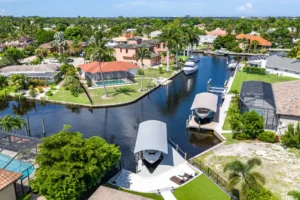
A gulf-access canal connects, by some route, to the Caloosahatchee River and out to the open Gulf of Mexico. This is the classic Cape Coral dream: keep a boat at your private dock and run out to Fort Myers Beach, Sanibel, Captiva, and the islands without ever trailering. These are saltwater canals, so they’re also where you’ll spot dolphins year-round and manatees in the cooler months, drifting right past the seawall.
If you plan to bring a boat, rent one, or book fishing and island trips from the house, this is the type you want. A couple of things to understand, though, because “gulf access” isn’t one-size-fits-all:
Direct vs. indirect access. Direct (or “sailboat”) access means no fixed bridges between the dock and the river — it works for any boat, including tall vessels and sailboats. Indirect access means you’ll pass under one or more low fixed bridges (sometimes around nine feet) on the way out, which limits how tall a boat can make the trip. If you’re bringing your own boat, this matters enormously — confirm the route fits your boat before you book. This Gulf Access & Bridge Height map can be helpful!
Travel time varies a lot. This is the big one renters miss: a home advertised as “gulf access” can still be anywhere from a few minutes to 30–45 minutes of idling from open water, depending on its location in the canal network. If a quick run to the Gulf is the dream, ask your host how long the boat ride actually takes.
Gulf-access homes are the premium product, so they generally rent at higher nightly rates — you’re paying for that direct line to the water.
Freshwater Canals
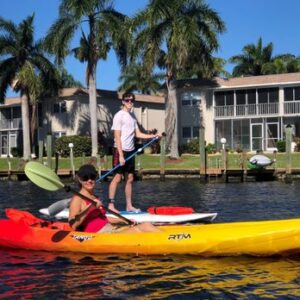
Freshwater canals are the quiet secret of Cape Coral. These are interior, landlocked waterways — mostly in the northeast and parts of the northwest of the city — that don’t connect to the river or the Gulf. Instead, they form a calm, closed system of canals and lakes fed by rain.
What you give up is saltwater boating and the run to the islands. What you get is genuinely lovely: serene, wide water views, much less boat traffic, and excellent calm-water recreation. Freshwater canals are ideal for kayaking, paddleboarding, jet skis, and small boats, and the fishing is fun in its own right — bass, tilapia, and other freshwater species. Some freshwater stretches open onto big, wide lakes with gorgeous views you won’t find on a narrow saltwater canal.
A few honest notes: you won’t see dolphins or manatees on a freshwater canal (those are saltwater animals), and alligators are more commonly spotted in freshwater systems — another good reason to admire the water rather than swim in it (more on swimming below). The upside for your wallet is real, though: freshwater-canal homes typically rent for noticeably less than comparable gulf-access homes, so they’re the value pick if a boat to the Gulf isn’t your goal.
Which One Is Right for Your Trip?
It comes down to a single question: what do you actually want to do on the water?
Choose a gulf-access (saltwater) rental if you want to bring or rent a boat, reach the Gulf and the islands from your dock, fish in saltwater, or watch for dolphins and manatees. It’s the right call for serious boaters and anyone whose vacation centers on getting out to open water.
Choose a freshwater rental if you mainly want beautiful water views, calm paddling, jet-skiing or small-boat fun, freshwater fishing, and a quieter, more private setting — at a friendlier price. For a lot of families and relaxers, this is plenty of waterfront, and the savings free up budget for other things.
The Questions to Ask Before You Book
A quick message to your host clears up almost everything. Before you book a waterfront rental, ask:
- Is the canal gulf-access (saltwater) or freshwater? The single most important question.
- If it’s gulf access, is it direct or indirect — and are there any fixed bridges or a lock on the route? Essential if you’re bringing a boat, since this sets the maximum boat height.
- How long is the boat ride from the dock to open water? So “gulf access” matches your expectations.
- Is there a dock, and a boat lift? And can you tie up your own boat, or is one available?
- If you don’t have a boat, where’s the nearest boat ramp or rental? Handy for freshwater stays too.
Any good host will happily answer these — and the answers tell you instantly whether a home fits your plans.
One Honest Note on Swimming
Because people often picture diving off the dock: Cape Coral’s canals generally aren’t meant for swimming. Freshwater canals can have alligators, and saltwater canals have boat traffic and murky, current-moved water. The water here is for boating, paddling, fishing, and wildlife-watching — and for swimming, you’ll want the home’s pool or a Gulf beach a short drive away. It’s not a drawback, just worth knowing so the layout of your trip matches reality.
The Bottom Line
In Cape Coral, “waterfront” is a spectrum, not a single thing. If life on the water means a boat at your dock and the Gulf at your bow, book a gulf-access home and confirm the route fits your boat. If it means peaceful views, easy paddling, and a better price, a freshwater canal may be exactly right. Match the canal to how you’ll actually spend your days, and the water becomes the best part of your whole trip.
Not sure which canal fits your plans? Just ask us. Tell us how you picture spending time on the water — boating to the islands, kayaking at sunrise, or simply sipping coffee with a view — and we’ll point you to the right home for your stay.
Keep planning: see our guide to the things to do once you’re here, and the local wildlife you’ll spot from the water.
If you’re choosing a winter base in Southwest Florida, you’ve probably narrowed it down to the big three: Cape Coral, Naples, and Fort Myers. They sit within about 40 minutes of each other, share the same gorgeous climate, and all draw snowbirds by the thousands every winter. So why do so many seasonal visitors keep choosing Cape Coral?
The honest answer is that none of these places is “better” in the abstract — they’re built for different priorities. But for a particular kind of snowbird, the one who wants space, water, value, and an unhurried pace, Cape Coral hits a sweet spot the other two can’t quite match. Here’s a fair look at how they compare, including where Naples and Fort Myers genuinely win, so you can decide what fits you.
More Vacation for Your Money
Let’s start with the one that matters to almost everyone: cost. Cape Coral simply stretches a budget further. As of early 2026, the median home price in Cape Coral sits around $375,000, compared to roughly $670,000 in Naples — and that gap shows up just as clearly in seasonal rentals as it does in real estate.
What that means in practice: in Cape Coral, your winter budget tends to get you a private single-family home with a heated pool and a canal out back. The equivalent money in Naples more often gets you a condo, frequently with hefty HOA fees attached (coastal Naples condo associations commonly run several hundred dollars a month). For snowbirds who want room to spread out, host visiting kids and grandkids, and live like they’re at home rather than in a hotel, the value equation tilts hard toward Cape Coral. Fort Myers lands somewhere in the middle — more affordable than Naples, but without Cape Coral’s waterfront-home-for-the-price advantage.
The Water Is the Whole Point
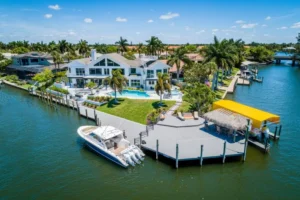
This is the big one, and it’s where Cape Coral is in a league of its own. The city is laced with more than 400 miles of navigable canals — the most of any city on earth — so a huge share of its homes come with a private dock and direct or near-direct access to the Gulf.
For a snowbird who boats, fishes, kayaks, or just wants to sip coffee watching dolphins and manatees drift past the seawall, that’s the dream: your boat is thirty feet from your back door, no marina, no trailer, no hassle. Neither Naples nor Fort Myers offers this at anything like the same scale or price. Naples has beautiful (and very expensive) waterfront, and Fort Myers has lovely river estates and marina communities, but neither has a residential canal network where waking up on the water is the norm rather than a luxury splurge. If life on the water is why you come to Florida, this single factor is why most water-lovers choose Cape Coral.
Space, Quiet, and an Easy Pace
Cape Coral was built as a residential city, not a resort strip, and you feel it. Big lots, wide quiet streets, low density, and a calm, safe, suburban feel make it one of Florida’s most livable large cities — peaceful, almost by design. For snowbirds who spent decades in busy places and want their winters to feel restful, that tranquility is a feature, not a shortcoming.
It also stays noticeably less hectic in peak season. Naples in February is glamorous but crowded and pricey; Cape Coral, even at its busiest, keeps a slower, more neighborly rhythm. You’re staying in a real community, not a tourist zone.
A Central Home Base for Everything Else
Choosing Cape Coral doesn’t mean giving up everything the others offer — it means having them within reach. From a Cape Coral base you’re a short drive from the world-class beaches and shelling of Sanibel and Captiva, the walkable River District and cultural scene of Fort Myers, and even Naples itself for a day of upscale shopping and dining. You get the quiet home base and the day trips. Many snowbirds find that the ideal setup is to live affordably and peacefully in Cape Coral and simply visit the pricier attractions when the mood strikes.
Where Naples Genuinely Wins

To be fair, Naples earns its premium, and it’s the better choice for some snowbirds. If your idea of a perfect winter is walking to the beach, fine dining on Fifth Avenue South, browsing art galleries and luxury boutiques, and teeing off at a private golf club, Naples delivers a polished, world-class version of that lifestyle that Cape Coral doesn’t try to match. It also has a slight edge in access to top-tier specialized healthcare. Naples is consistently ranked among the best places to retire in Florida by U.S. News & World Report, and for good reason. If beaches-at-your-doorstep and upscale refinement top your list and budget isn’t the deciding factor, Naples may be your place.
Where Fort Myers Genuinely Wins
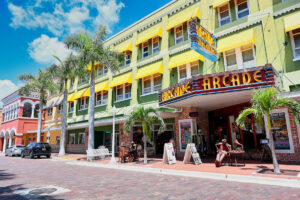
Fort Myers makes a strong case too, especially if you want more buzz than Cape Coral offers. Its historic downtown River District is the most genuinely walkable neighborhood in the region — restaurants, bars, art walks, and live music steps from your door. It has real cultural depth (the Edison & Ford Winter Estates, theaters, an arts scene) and is the area’s hub for spring training baseball, a huge draw for snowbirds in February and March. It’s also closest to the Southwest Florida International Airport (RSW) and home to the region’s major hospital campuses. If walkability, culture, and convenience rank above space and a private dock, Fort Myers might fit you better.
The Bottom Line for Snowbirds
Here’s the honest summary. Choose Naples for beaches and luxury, Fort Myers for walkable downtown energy and convenience — and Cape Coral for space, water, value, and calm.
For the large group of snowbirds whose priorities are a private waterfront home, room to relax, an easy boating-and-wildlife lifestyle, and a budget that goes further, Cape Coral isn’t a compromise — it’s the best fit on the coast. That’s why so many people who try it here come back to the same canal every winter.
Thinking about a winter on the water in Cape Coral? We’d love to help you find the right home base for your season. Reach out with your dates and what you’re looking for, and we’ll point you toward the neighborhoods and rentals that fit, or take a look for yourself.
Plan your stay with our other guides: what to know about gulf-access vs. freshwater canals, and the things to do and wildlife to see once you’re here.
<!– INTERNAL LINKS TO ADD ONCE LIVE: – “book a Cape Coral winter rental” → Snowbird booking guide (Jul) – “gulf-access vs. freshwater canals” → Gulf-access canals post (Aug)